Waypoint.
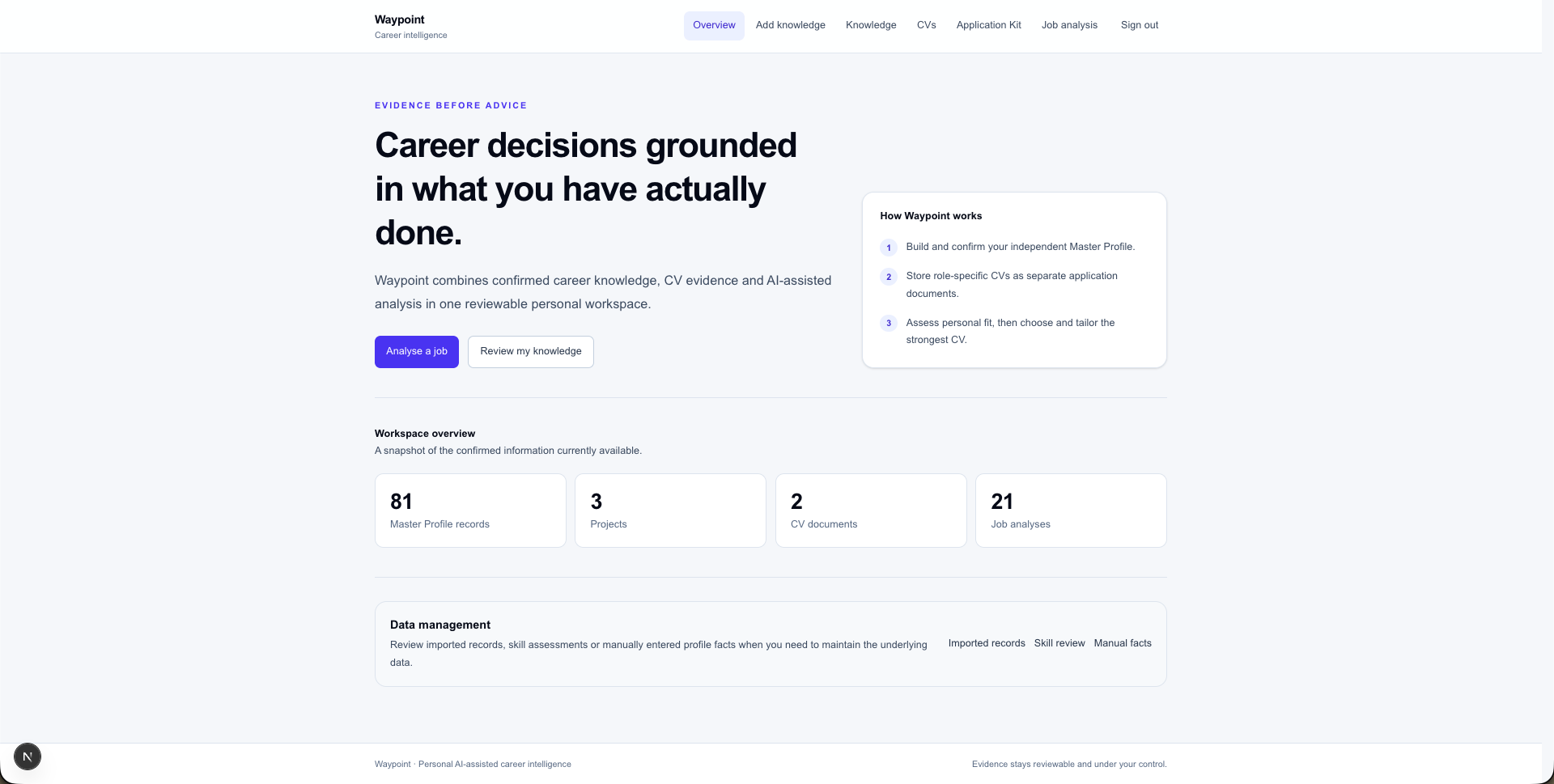
I shaped the product concept, information architecture and interface, then built an evidence-based workspace for career knowledge, CVs, job analysis and reusable application answers.
Delivered
Built and deployed a prototype for career knowledge, job analysis, CV selection and reusable application details.
- Scope
- Responsive web application · Career intelligence dashboard
- Role
- Product Owner · UX/UI Designer · Full-Stack Developer · AI Systems Designer
- Timeline
- Iterative personal project · 2026
01 / CONTEXT
Problem and response
Challenge
Career information is usually scattered across CV files, job descriptions, application forms and opaque AI conversations. That makes it difficult to know what is proven, what is missing and what should be improved.
Response
Waypoint creates a confirmed and editable career knowledge base, compares it with atomic job requirements, separates supported evidence from unknowns and conflicts, and recommends the most suitable stored CV with clear tailoring guidance.
02 / CONTRIBUTION
My contribution
Contribution
- +Shaped the product concept and information architecture around reusable career evidence.
- +Designed editable career records and explainable job-fit workflows.
- +Built the application with Next.js, TypeScript, Supabase and PostgreSQL.
03 / DECISIONS
How the system took shape
- 01
Made every recommendation traceable to confirmed evidence, an unknown or a genuine conflict.
- 02
Designed career knowledge as editable records with proficiency and supporting evidence rather than a one-time import.
- 03
Focused application support on reusable answers and clear tailoring actions instead of generating generic copy.
- 04
Built the full-stack application with Next.js, TypeScript, Supabase and PostgreSQL.
- 05
Used Zod and Vitest to validate boundaries and protect the reliability of analysis workflows.
- 06
Used OpenAI and Groq provider adapters behind explicit product rules so AI assistance supports explainable system behaviour.
Product context and reasoning
- Separated a person’s career profile from any single CV so the underlying evidence can be reused across applications.
- Modelled job descriptions as atomic requirements so recommendations can explain fit instead of returning one opaque score.
- Separated each account’s career workspace so personal evidence remains private.
04 / OUTCOME
Outcome and reflection
Built and deployed a career workspace for editable career knowledge, evidence-based job analysis, CV selection and reusable application details. The public entry point offers account creation and sign-in; AI-assisted workflows use the user’s own supported provider key.
Deployment demonstrates an accessible application, not measured adoption or hiring outcomes. Recommendations still require the user to review the underlying career evidence.
The central design challenge was making AI useful without making it mysterious. The product became clearer once every recommendation had to point back to evidence the user could inspect and correct.